Mechanism module
Package: com.crossbotics.ftchelper.mechanism
Learn it hands-on: 14 Mechanisms. Example: Drive + intake.
Ready-made helpers for the four kinds of mechanism almost every robot has. Each one is a
Subsystem, connects to buttons with one line, and gives autonomous
steps with one call. The robot in five files’s Lift, Arm, Claw and other parts are
built on them, so with five files you rarely make them yourself. Use them in your own mechanism
class, or for a part five files has no module for. Start with tutorial 14.
| Class | For | Hardware |
|---|---|---|
PositionMotor |
lifts, arms, slides, motor claws: go to named positions and hold | motor + encoder |
SpinMotor |
intakes, rollers, conveyors: in / out / stop, jam back-out | motor |
PositionServo |
claws, wrists, hoods, gates: named positions or degrees | servo |
SpinServo |
small rollers and spinners | continuous-rotation servo |
flowchart LR
BTN["Button<br/>bindPress(..., () -> lift.goTo("HIGH"))"] --> CMD["Command<br/>(quick: sets the target)"]
STEP["Autonomous step<br/>lift.goToStep("HIGH")"] --> CMD
CMD --> UPD["update() every loop<br/>PID + limits + switch"] --> HW["Motor"]
Two rules for all of them:
- Commands (
goTo,in,toggle…) are quick and safe to call from a button. Motor helpers act inupdate(), once per loop: callupdate()every loop (or put them in aSubsystemsgroup). - Servo commands move the servo AT ONCE. That is how servos work. (With
.maxSpeed(), the first move happens at once andupdate()does the rest in small steps.) So never call a command in INIT unless that movement is allowed and safe: nothing may move before START.
A typo in a position name (goTo("HGIH")) does nothing and shows a warning on the Driver
Station, so it can never stop the OpMode in a match. getWarning() returns it.
PositionMotor
Section titled “PositionMotor”Everything from tutorials 07, 08 and 12 in one helper:
- PID to reach a position and hold it (PidController).
- Soft limits: code that never pushes past the safe range.
- A bottom switch with homing: pressing the switch sets the position to 0, so the count is right.
- A slow zone near the ends, so it does not slam.
- Named positions, stepping between them, control by hand that holds where you let go, live tuning, and autonomous steps.
PositionMotor lift = PositionMotor.create(hardwareMap, "lift") .limits(0, 2600) // safe range, encoder ticks .lowerSwitch(hardwareMap, "lift_bottom") // touch sensor at the bottom: resets to 0 .slowZone(250, 0.2) // last 250 ticks: power down to 0.2, no slamming .pid(0.004, 0, 0.0002, 0.05) // kP, kI, kD, kF (0.05 holds it up) .position("DOWN", 0) // named heights, ticks: measure yours .position("LOW", 900) .position("HIGH", 2400) .tunable("Lift"); // put the numbers in the tuning menuSetup (chain them; positive power must move toward bigger positions):
| Method | What it does |
|---|---|
PositionMotor.create(hardwareMap, name) |
gets the motor: brake, encoder zeroed, plain power |
new PositionMotor(name, motor) |
wraps a motor you already have |
.reversed() |
positive power the other way (call first) |
.units(ticksPerUnit, "deg") |
work in degrees/inches instead of ticks. Must come FIRST: calling it after limits, positions, slowZone or tolerance stops with a clear error |
.limits(min, max) |
the safe range |
.lowerSwitch(hardwareMap, name) / .lowerSwitch(reader) |
bottom switch: stops downward power and homes (sets position 0). Until homed, only slow downward power works. A name not in the configuration shows a warning, and it runs without a switch |
.upperSwitch(reader) |
top switch |
.slowZone(distance, powerAtLimit) |
slow near the ends |
.maxPower(p) |
most power ever |
.pid(kP, kI, kD, kF) |
gains (on the error in UNITS) |
.tolerance(units) |
“there” when this close (default: about 20 ticks) |
.position(name, value) |
a named position |
.holdWhenReleased(bool) |
after manual control, hold where it was let go (default true) |
.stepTimeout(seconds) |
how long autonomous steps wait (default 3) |
.tunable(prefix) |
gains and positions in the tuning menu; call LAST |
Commands and reading:
| Method | What it does |
|---|---|
goTo(name) / goTo(value) |
go there and hold |
stepUp() / stepDown() |
next named position up / down (by value) |
manual(power) |
call every loop with a stick; non-zero takes over, 0 = hold where it is |
hold(), stop(), zeroHere() |
hold here / no power / make here zero |
update() |
every loop |
isAtTarget(), isAt(name), getPosition(), getTargetName() |
read (“hand”, “hold”, “none” or the name) |
isWaitingForHoming() |
true until the bottom switch was pressed once |
goToStep(name) |
autonomous: go and wait until there |
startStep(name) |
autonomous: start going and continue at once (moves during the next steps) |
getSafeMotor(), getPid() |
the layers inside |
Telemetry: standard = target and position; debug = target value, power asked/sent, limits, homed.
Per loop on the hub (from its SafeMotor): one encoder read (update() reads it fresh, and the PID and
telemetry reuse it for 3 ms, so a reading is at most 3 ms old); a power is sent only when it changes,
and again every 25 loops (every loop while past a soft limit), so a power written straight to
getSafeMotor().getMotor() lasts at most 25 loops. The launcher’s
Turret reads its encoder the same way (at most once per 3 ms). All the details:
what runs every loop.
SpinMotor
Section titled “SpinMotor”SpinMotor intake = SpinMotor.create(hardwareMap, "intake") .powers(1.0, -0.7) // in, out .jamDetection(80, 0.3, 0.4); // < 80 ticks/s for 0.3 s = jam; back out 0.4 s| Method | What it does |
|---|---|
create(hardwareMap, name) |
gets the motor: coast, plain power |
.reversed(), .powers(in, out) |
direction and powers |
.jamDetection(minSpeed, jamSec, unjamSec) |
while IN: a jam (motor powered but barely turning) is backed out, then IN again (needs the encoder cable) |
.jamCurrent(amps) |
also a jam when the motor draws too much current |
in(), out(), stop() |
safe to call every loop (in() does not interrupt a jam back-out) |
toggleIn(), toggleOut() |
for one button |
setPower(p) |
any power, e.g. from a trigger |
getState() |
STOPPED, IN, OUT, UNJAMMING, MANUAL |
getJamCount(), isRunning() |
read |
inStep(), outStep(), stopStep(), outForStep(seconds) |
autonomous steps |
A common pattern: “reverse wins, then on/off”:
// every loop; reverseHeld and intakeOn are your own true/false values (e.g. from buttons)if (reverseHeld) intake.out();else if (intakeOn) intake.in();else intake.stop();intake.update(); // only here does the motor actually get its powerPer loop on the hub: update() sends the power only when it changes, and again every 25 writes
(one write per update()), so a power written straight to getMotor() lasts at most 25 loops. While
running IN with jam detection, it reads the speed every loop (part of a bulk read) and, with
.jamCurrent(...), the current: getCurrent() is a separate hub command each loop, not part of a
bulk read, so add it only if the speed check is not enough.
PositionServo
Section titled “PositionServo”PositionServo claw = PositionServo.create(hardwareMap, "claw") .position("OPEN", 0.20) // raw servo positions, 0 to 1: find yours by testing .position("CLOSED", 0.75) .travelTime(0.3); // seconds for a full 0..1 move (measure it)
PositionServo hood = PositionServo.create(hardwareMap, "hood") .degrees(0.10, 0, 0.90, 25); // two measured points: raw 0.10 = 0 deg, raw 0.90 = 25 deghood.setDegrees(18); // moves the servo at once (servos do)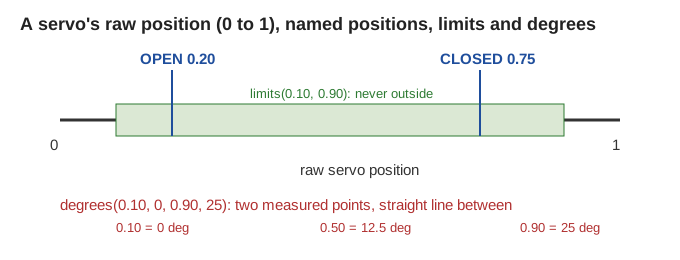
| Method | What it does |
|---|---|
create(hardwareMap, name) |
gets the servo; does NOT move it |
.reversed() |
0 and 1 swap ends |
.limits(min, max) |
never past these raw positions (keeps it off the frame) |
.position(name, raw) |
a named raw position (0..1) |
.degrees(posA, degA, posB, degB) |
use degrees, from two measured points |
.travelTime(seconds) |
time for a full 0..1 move: used to guess “arrived” (a servo cannot report its position) |
.maxSpeed(perSecond) |
move slowly (raw positions per second). After a pause in update() calls it goes on slowly; it never jumps the rest of the way |
.tunable(prefix) |
positions in the tuning menu; call LAST |
goTo(name), set(raw), setDegrees(deg) |
move |
toggle(a, b), next(), previous() |
for buttons |
isDone() |
true when it should have arrived (estimate) |
getPosition(), getDegrees(), getTargetName() |
read |
getTargetDegrees() |
the angle it is going to (after its limits); differs from getDegrees() only during a slow move |
goToStep(name) |
autonomous: move and wait until it should have arrived |
update() |
every loop (needed for slow moves and “done”) |
SpinServo
Section titled “SpinServo”For a servo in continuous rotation mode (set the port as “Continuous Rotation Servo” in the configuration).
SpinServo roller = SpinServo.create(hardwareMap, "roller").power(0.8);// hold X = spin forward at 0.8; let go = stop. roller::forward = "() -> roller.forward()"controls.bindHold(Pad.G2, Btn.X, roller::forward).bindRelease(Pad.G2, Btn.X, roller::stop);| Method | What it does |
|---|---|
.reversed(), .power(p) |
direction and power for forward/backward |
.angleSensor(hardwareMap, name, maxVolts) |
read the angle from an analog wire (e.g. Axon servos) |
forward(), backward(), stop(), setPower(p) |
spin |
runFor(seconds, power) |
spin, then stop by itself |
isRunning(), getPower(), getAngleDeg() |
read |
runForStep(seconds, power) |
autonomous step |
update() |
every loop (needed for runFor) |